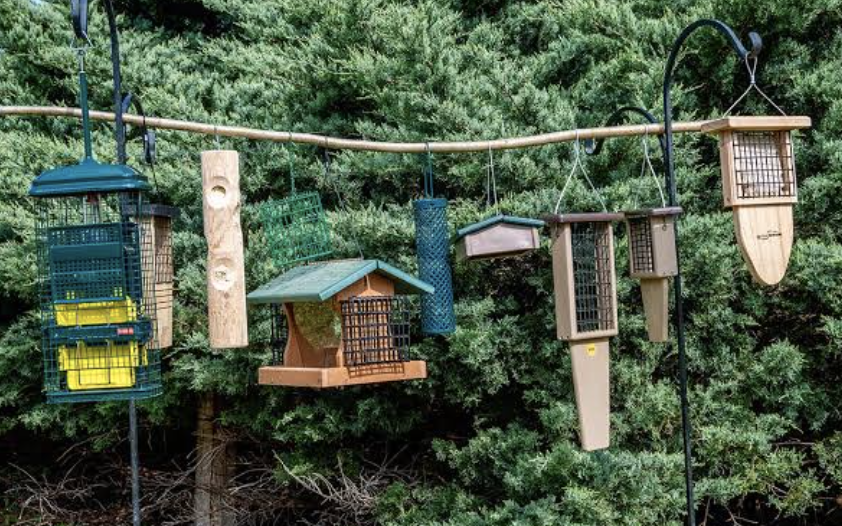
A bird feeder placed outdoors has to survive far more than just birds. Rain, sun, frost, wind, and temperature changes all test its materials every day of the year.
The most weatherproof bird feeders use UV-stabilised plastic, powder-coated metal, stainless steel components, and durable glass or reinforced polycarbonate elements designed to resist rust, fading, and cracking.
Choosing the right material is the difference between a feeder that lasts one season and one that performs reliably for years.
Why Weatherproof Materials Matter for Bird Feeders
Outdoor bird feeders are constantly exposed to changing environmental conditions. Without weather-resistant materials, they quickly degrade and become unsafe or unusable.
Weatherproof materials matter because they prevent rust, cracking, fading, mold growth, and structural failure, ensuring the feeder remains safe, functional, and attractive for birds throughout all seasons.
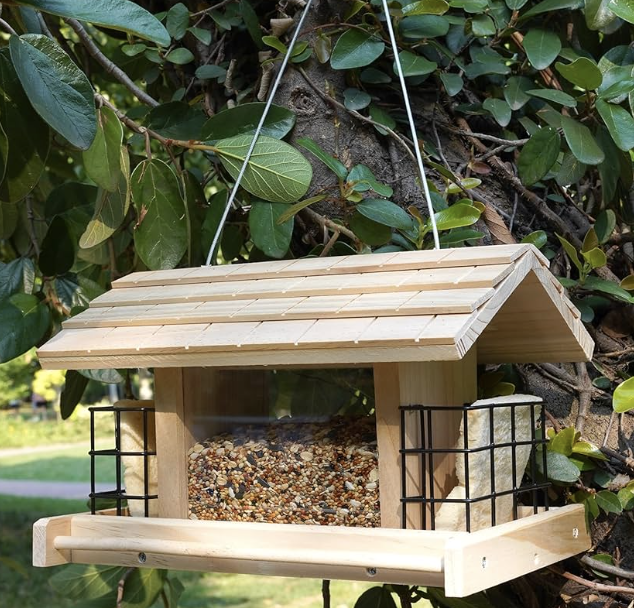
A feeder is not just a decorative garden item. It is a food container that must remain hygienic and structurally stable in all weather conditions.
Rain and moisture are the biggest threats
Water is one of the main causes of feeder failure.
It can lead to:
- rust on metal parts;
- swelling or warping in wood;
- mold growth in seed compartments;
- clogged feeding ports;
- spoiled bird seed;
- slippery surfaces that reduce grip.
Once moisture enters poorly designed feeders, it is difficult to fully remove.
Sunlight causes long-term material breakdown
UV exposure gradually damages many common materials[^1].
Over time, it can cause:
- plastic becoming brittle[^2];
- faded colors losing visual appeal;
- weakened structural joints;
- degraded rubber seals;
- reduced flexibility in hanging parts.
A feeder that looks fine in its first season may become fragile after prolonged sun exposure.
Cold weather creates hidden stress
Freezing temperatures and frost can cause:
- cracking in weak plastic;
- expansion and contraction of metal joints;
- frozen seed blocking access;
- brittle ribbon or decorative parts;
- condensation inside enclosed compartments.
Feeders that perform well in winter must handle both moisture and temperature extremes.
Wind adds mechanical pressure
Strong wind constantly tests:
- hanging hooks;
- feeder balance;
- frame stability;
- joint strength;
- mounting systems.
Even a lightweight feeder can fail if its connection point is not designed for outdoor stress.
| Weather factor | Common damage | Result |
|---|---|---|
| Rain | Rust and mold | Food contamination |
| Sunlight | UV degradation | Material brittleness |
| Frost | Expansion cracks | Structural failure |
| Wind | Mechanical stress | Dropping or breakage |
A truly durable feeder is designed for real outdoor conditions, not just garden display.
Comparing the Most Durable Bird Feeder Materials
Different materials offer different levels of durability, maintenance, and long-term performance.
The most durable bird feeder materials include powder-coated metal, stainless steel, UV-stabilised plastic, glass, and treated wood, each offering different advantages depending on climate, bird activity, and placement.
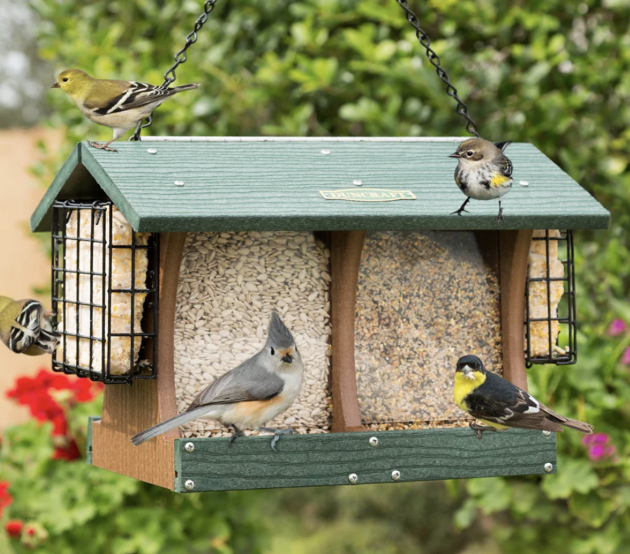
No single material is perfect. The best choice depends on how and where the feeder will be used.
Powder-coated metal
Powder-coated metal is one of the most reliable outdoor materials.
It offers:
- strong structural support;
- resistance to rust (when coating is intact);
- good predator resistance;
- long service life;
- stable hanging performance.
However, if the coating is scratched or damaged, rust can develop over time.
It is especially suitable for:
- seed tube feeders;
- cage-style feeders;
- heavy-duty outdoor stations;
- high-wind environments.
Stainless steel
Stainless steel is highly durable and corrosion-resistant[^3].
Advantages include:
- excellent rust resistance;
- long lifespan;
- easy cleaning;
- strong structural integrity;
- modern appearance.
It is commonly used in:
- premium feeders;
- suet feeders;
- high-end garden setups.
The main drawback is cost, as stainless steel feeders are usually more expensive[^4].
UV-stabilised plastic
High-quality plastic feeders are widely used because they are lightweight and cost-effective.
Good UV-stabilised plastic offers:
- resistance to sunlight damage;
- lightweight structure;
- easy installation;
- affordable pricing;
- design flexibility.
However, low-quality plastic can:
- crack in cold weather;
- fade under sunlight;
- become brittle over time.
Plastic feeders are best for moderate climates and general garden use.
Glass components
Glass is often used in seed storage tubes or nectar feeders.
Benefits include:
- non-porous surface (hygienic);
- easy to clean;
- weather-resistant surface;
- long-lasting transparency.
Risks include:
- breakage from impact;
- heavier weight;
- sensitivity to sudden temperature changes.
Glass is often paired with metal frames for added protection.
Treated wood
Wood provides a natural aesthetic but requires protection.
Advantages:
- attractive natural appearance;
- good insulation properties;
- blends into garden environments.
Disadvantages:
- needs weather treatment;
- can absorb moisture;
- may warp or crack over time;
- requires more maintenance.
Treated hardwood performs better than softwood in outdoor conditions.
| Material | Durability | Maintenance | Best use |
|---|---|---|---|
| Powder-coated metal | Very high | Low | General outdoor feeders |
| Stainless steel | Very high | Very low | Premium feeders |
| UV plastic | Medium–high | Low | Everyday feeders |
| Glass | Medium | Medium | Seed or nectar containers |
| Treated wood | Medium | High | Decorative garden feeders |
For long-term outdoor use, the best approach is often combining strong structure with weather-resistant surfaces.
Features That Improve Outdoor Durability
Material alone is not enough. Design features also determine how long a bird feeder lasts outdoors.
Durability improves when bird feeders include protective roofs, drainage systems, reinforced hanging points, predator-resistant cages, sealed seed compartments, and easy-clean structures that reduce long-term wear.
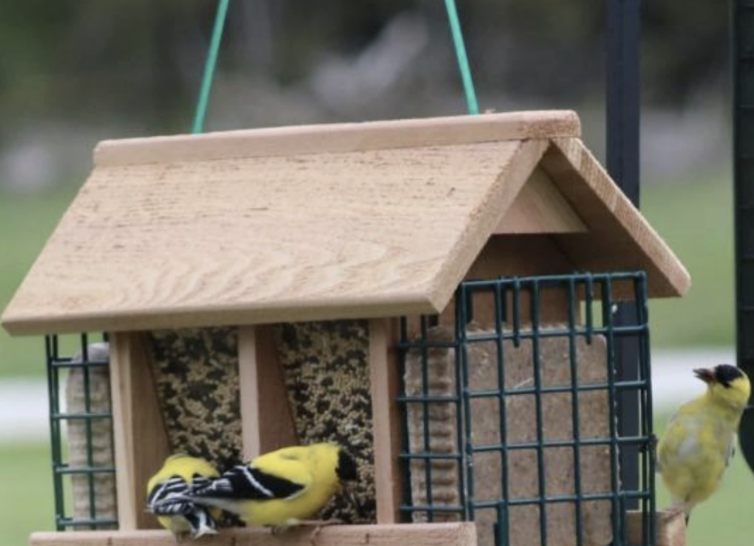
A well-designed feeder protects both the food and the structure itself.
Protective roofs and covers
A simple roof can significantly improve durability.
It helps:
- block direct rain;
- reduce snow buildup;
- keep seed dry;
- protect feeding ports;
- extend material lifespan.
Even small covers make a noticeable difference in wet climates.
Drainage and airflow design
Water buildup is one of the fastest ways to damage a feeder.[^5]
Good feeders include:
- drainage holes;
- open airflow sections;
- sloped surfaces;
- water-resistant compartments.
This prevents mold and keeps seed fresher for longer.[^6]
Reinforced hanging systems
The hanging point is often the weakest part of a feeder.
Stronger designs include:
- metal hooks instead of plastic;
- reinforced top rings;
- balanced weight distribution;
- anti-swing structures;
- secure mounting options.
This is especially important in windy areas.
Predator-resistant structures
Durability also includes protection from animals.
Features may include:
- metal cages around feeders;
- small feeding ports;
- anti-squirrel designs;
- weight-activated closures;
- reinforced access points.
These features prevent damage and food loss.
Easy-clean construction
A feeder that is difficult to clean often degrades faster because users neglect maintenance.
Better designs allow:
- full disassembly;
- smooth internal surfaces;
- wide openings for brushing;
- minimal hidden corners;
- quick drying after washing.
Clean feeders last longer and remain more attractive to birds.
| Feature | Durability benefit | Bird impact |
|---|---|---|
| Roof cover | Protects from rain | Keeps food dry |
| Drainage system | Prevents water buildup | Reduces mold risk |
| Metal hooks | Stronger support | Safer hanging |
| Predator cage | Prevents damage | Protects food supply |
| Easy cleaning design | Longer lifespan | Healthier feeding |
A durable feeder is essentially a weather-resistant feeding system, not just a container.
Choosing the Best Weatherproof Bird Feeder for Long-Term Use
The best feeder is not always the most expensive one—it is the one that matches your environment, bird activity, and maintenance habits.
The best weatherproof bird feeder combines durable materials, protective design features, and easy maintenance, while matching the local climate and bird species in your garden.
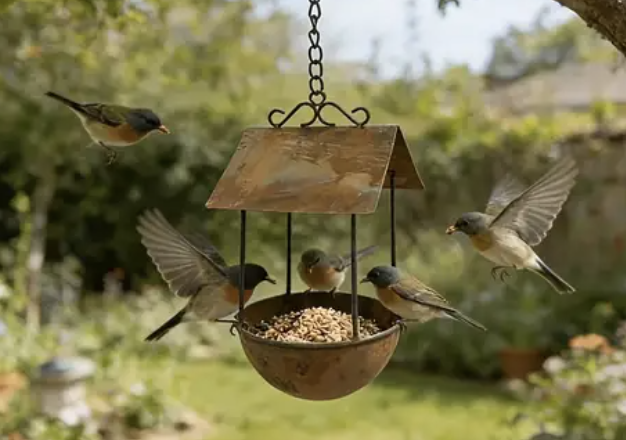
Different gardens require different solutions.
A coastal garden, for example, has very different challenges compared to an inland suburban garden.
Match feeder type to environment
- Wet climates: prioritise drainage and roof protection
- Sunny climates: prioritise UV-stabilised materials
- Windy areas: prioritise strong metal frames and hooks
- Cold climates: prioritise frost-resistant components
Match feeder type to bird species
Different feeders attract different birds:
- tube feeders → small songbirds
- platform feeders → mixed species
- suet feeders → insect-eating birds
- ground feeders → robins and thrushes
Choosing the right feeder improves both bird activity and feeder longevity.
Consider long-term maintenance
A good long-term feeder should be:
- easy to refill;
- simple to clean[^7];
- resistant to clogging;
- durable under repeated use;
- stable in outdoor conditions.
If maintenance is too difficult, even a durable feeder may fail in practice due to neglect.[^8]
Balance price and lifespan
Cheaper feeders may seem attractive but often need replacement sooner.
A higher-quality feeder may:
- last multiple seasons;
- reduce replacement cost;
- require fewer repairs;
- maintain better bird activity.
| Buying factor | What to prioritise |
|---|---|
| Durability | Metal or UV-stabilised materials |
| Climate fit | Weather-specific features |
| Maintenance | Easy cleaning design |
| Bird type | Suitable feeding ports |
| Long-term value | Multi-season lifespan |
The best decision is to choose a feeder that fits your garden conditions rather than just your budget.
Conclusion
Weatherproof bird feeders are defined by material quality, smart design, and suitability for outdoor conditions. When these elements work together, the feeder becomes a long-lasting and reliable part of your garden ecosystem.
[^1]: "Photodegradation – Wikipedia", https://en.wikipedia.org/wiki/Photodegradation. Materials-science references describe ultraviolet radiation as a cause of photodegradation in polymers and other materials, including chemical bond scission and oxidation that can reduce mechanical performance over time. Evidence role: mechanism; source type: encyclopedia. Supports: UV exposure gradually damages many common materials.. Scope note: This supports the general mechanism of UV-related material degradation, but the rate and severity depend on the specific material formulation, additives, and exposure conditions.
[^2]: "Oxidation and fragmentation of plastics in a changing … – PMC", https://pmc.ncbi.nlm.nih.gov/articles/PMC9765214/. Polymer-aging studies report that ultraviolet exposure can initiate photo-oxidative degradation in plastics, which may lead to embrittlement and loss of mechanical properties. Evidence role: mechanism; source type: paper. Supports: Over time, UV exposure can cause plastic to become brittle.. Scope note: This evidence would directly support embrittlement as a known outcome for many plastics, but not every plastic type or stabilizer package responds identically.
[^3]: "[PDF] The Role of Passive Film Growth – Kinetics and Properties in", https://nvlpubs.nist.gov/nistpubs/Legacy/IR/nbsir75-916.pdf. Materials references describe stainless steel as an iron alloy containing chromium that forms a passive oxide layer, which gives the material broad corrosion resistance and contributes to its durability in many environments. Evidence role: mechanism; source type: encyclopedia. Supports: Stainless steel is highly durable and corrosion-resistant.. Scope note: Corrosion resistance varies by stainless-steel grade and exposure conditions, especially in chloride-rich or highly acidic environments.
[^4]: "[PDF] Basic facts about stainless steel – Worldstainless", https://worldstainless.org/wp-content/uploads/2025/02/basic-facts-about-stainless-steel.pdf. Consumer and manufacturing cost references generally note that stainless steel products tend to cost more than comparable plastic or plain steel products because alloying elements such as chromium and nickel, processing requirements, and fabrication costs raise material and production expenses. Evidence role: general_support; source type: institution. Supports: The main drawback is cost, as stainless steel feeders are usually more expensive.. Scope note: This supports the general cost relationship for stainless-steel goods rather than providing feeder-specific price data.
[^5]: "Feeding backyard birds in Arkansas", https://www.uaex.uada.edu/environment-nature/wildlife/backyard-habitat/feeding-backyard-birds.aspx. Guidance from bird-conservation or extension sources describes wet birdseed and retained moisture in feeders as conditions that promote mold, spoilage, and sanitation problems, supporting the claim that water accumulation can quickly compromise feeder condition and use. Evidence role: general_support; source type: institution. Supports: Water buildup is one of the fastest ways to damage a feeder.. Scope note: Such sources typically address feeder hygiene and seed spoilage rather than ranking water buildup against all possible causes of feeder damage.
[^6]: "Sunflower-Production Guide – Texas A&M AgriLife Research and …", https://sanangelo.tamu.edu/agronomy/agronomy-publications/sunflower-production-guide/. University extension and bird-health guidance commonly notes that moisture encourages mold growth in birdseed and recommends dry, well-drained feeders to reduce spoilage, supporting the mechanism by which drainage and airflow help keep seed usable longer. Evidence role: mechanism; source type: education. Supports: Drainage holes, airflow, sloped surfaces, and water-resistant compartments help prevent mold and keep seed fresher for longer.. Scope note: The evidence supports the general moisture-mold relationship and feeder hygiene practice, but it may not quantify exactly how much longer seed remains fresh.
[^7]: "Bird-feeder cleaning lowers disease severity in rural but not urban …", https://pmc.ncbi.nlm.nih.gov/articles/PMC8213693/. Bird-feeding guidance from ornithological and wildlife-health institutions commonly emphasizes routine cleaning of feeders to reduce pathogen transmission, supporting cleanability as a practical design requirement for long-term use. Evidence role: expert_consensus; source type: institution. Supports: A good long-term feeder should be simple to clean.. Scope note: This supports the importance of cleanability for safe maintenance, but it does not rank specific feeder designs.
[^8]: "Bird-feeder cleaning lowers disease severity in rural but not urban …", https://pmc.ncbi.nlm.nih.gov/articles/PMC8213693/. Studies and wildlife-health guidance on bird feeders note that poorly maintained feeders can accumulate spoiled food or pathogens, indicating that maintenance practices affect whether a feeder remains functional and safe over time. Evidence role: general_support; source type: research. Supports: If maintenance is too difficult, even a durable feeder may fail in practice due to neglect.. Scope note: The evidence would support the maintenance-risk relationship in general rather than directly proving that difficult maintenance causes neglect in all feeder owners.