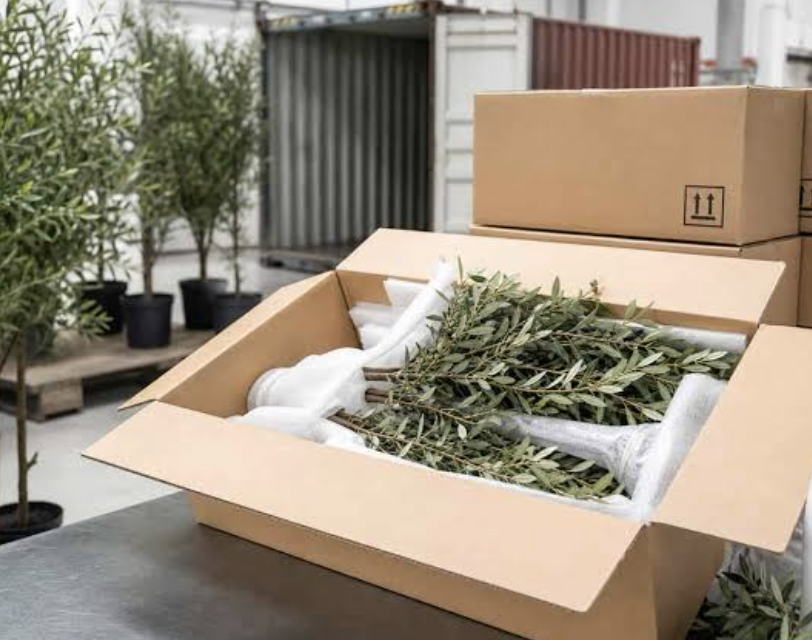
OEM artificial plants have become a popular choice for importers looking to create unique garden, home décor, and commercial decoration product lines.
OEM artificial plant sourcing allows importers to customise designs, materials, colours, packaging, and branding while working with manufacturers to create products that match their target market needs.
For successful importing, buyers need to understand customisation options, quality control, production preparation, and logistics management.
What Can Be Customized When Ordering OEM Artificial Plants?
OEM artificial plants offer much more flexibility than standard products because buyers can adjust different elements according to their market requirements.
When ordering OEM artificial plants, importers can usually customise plant styles, materials, colours, sizes, pots, packaging, labels, and branding elements to create unique products.

Many retailers do not want identical products that competitors can easily sell.
Customisation helps businesses create:
- exclusive product ranges;
- stronger brand identity;
- higher retail value;
- better market differentiation.
Plant design and appearance
One of the most common OEM options is changing the plant design.
Importers can customise:
- plant species;
- leaf shapes;
- branch structures;
- flower styles;
- plant density;
- overall appearance.
Examples include:
- artificial eucalyptus plants;
- artificial olive trees;
- artificial hanging plants;
- artificial boxwood panels;
- artificial tropical plants.
Different markets often prefer different styles.
European customers may prefer:
- natural colours;
- minimalist designs;
- realistic greenery.
Commercial customers may prefer:
- larger sizes;
- stronger visual impact;
- easy installation.
Size and shape customisation
Artificial plants can be adjusted for different applications.
Custom options include:
- height;
- width;
- leaf arrangement;
- pot size;
- hanging length.
For example:
A retailer selling balcony products may need compact artificial plants.
A hotel or shopping centre may require large decorative artificial trees.
Material selection
Importers can also choose different materials.
Common materials include:
- PE plastic;
- PVC;
- silk fabric;
- polyester;
- wire structures;
- natural wood bases.
Different materials create different:
- appearance;
- durability;
- price levels.
Pot and container options
The plant itself is only one part of the product.1
OEM options may include:
- plastic pots;
- ceramic pots;
- cement-style pots;
- woven baskets;
- decorative planters.
This allows retailers to create complete ready-to-sell products2.
Branding and packaging
Importers can customise:
- logo printing;
- product tags;
- colour boxes;
- instruction cards;
- retail packaging.
Private label packaging helps retailers build recognition.
| Customisation area | Examples |
|---|---|
| Plant design | Species, leaves, flowers |
| Size | Height and shape |
| Materials | PE, PVC, fabric |
| Pots | Plastic, ceramic, decorative containers |
| Packaging | Labels, boxes, branding |
OEM allows importers to create products designed specifically for their customers.
How to Evaluate Materials, Realism, and Product Quality
The biggest challenge with artificial plants is achieving a realistic appearance while maintaining durability and competitive cost.
Importers should evaluate artificial plants based on material quality, colour accuracy, leaf structure, craftsmanship, durability, and overall realism before placing large orders.
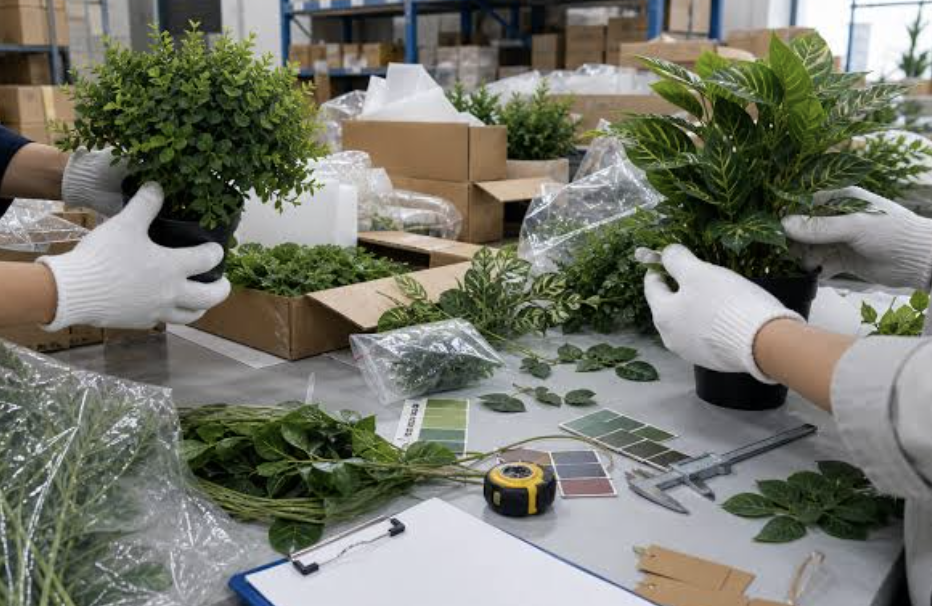
A low-quality artificial plant may look acceptable in photos but disappoint customers after receiving the product.
Quality evaluation should include several important factors.
Material quality
Materials directly affect:
- appearance;
- lifespan;
- flexibility;
- outdoor performance.
For example:
PE materials
- strong outdoor performance;
- realistic texture;
- suitable for gardens.
PVC materials
- lower cost;
- flexible designs;
- suitable for indoor decoration.
Fabric materials
- soft appearance;
- suitable for flowers and premium designs.
The right material depends on product positioning.
Realistic leaf and flower design
Customers usually judge artificial plants by realism.
Important details include:
- natural colour variation;
- realistic leaf veins;
- different leaf sizes;
- natural branch movement;
- suitable plant density.
A completely uniform design often looks artificial.
Better products include small variations that imitate real plants.
Colour quality
Colour is a key selling point.3
Poor colour control can create:
- unrealistic appearance;
- inconsistent batches;
- customer complaints.
Importers should check:
- sample colour;
- production colour;
- sunlight appearance;
- long-term fading resistance4.
Structure and craftsmanship
Quality also depends on production details.
Check:
- leaf attachment;
- branch strength;
- wire structure;
- pot stability;
- assembly quality.
Common defects include:
- loose leaves;
- weak stems;
- uneven shape;
- poor finishing.
Outdoor durability
For outdoor artificial plants, buyers should consider:
- UV resistance;
- weather exposure;
- moisture resistance;
- temperature changes.
Garden products require stronger performance than indoor decoration.
| Quality factor | Why it matters |
|---|---|
| Material | Determines durability |
| Leaf design | Creates realism |
| Colour control | Improves appearance |
| Craftsmanship | Reduces defects |
| UV resistance | Supports outdoor use |
Good material selection helps importers create artificial plants that customers trust and continue buying.
What Should Importers Check Before Mass Production?
Before starting mass production, importers should confirm every important detail to avoid expensive changes later.
Before mass production, importers should approve samples, confirm specifications, check packaging designs, verify production capability, and establish clear quality standards with the manufacturer.

Many production problems happen because buyers move into bulk production too quickly.
A careful preparation stage reduces risk.
Approve final samples
The approved sample becomes the production reference.
Check:
- plant appearance;
- colour;
- materials;
- size;
- pot design;
- packaging.
Do not rely only on product pictures.
Physical samples provide much better confirmation.
Confirm technical specifications
Before production, confirm:
- product dimensions;
- material details;
- weight;
- packaging size;
- carton quantity;
- product assembly method.
Clear specifications prevent misunderstandings.
Check production capability
Importers should evaluate whether the factory can handle the order5.
Important factors:
- production capacity;
- skilled workers;
- material supply;
- quality control process;
- previous export experience.
A supplier may produce good samples but struggle with large quantities6.
Prepare quality standards
Define acceptable standards before production.
Examples:
- colour tolerance;
- acceptable defects;
- packaging requirements;
- inspection method.
This creates a clear reference for both sides.
Review packaging before mass production
Packaging should be approved early.
Check:
- carton size;
- product protection;
- retail presentation;
- shipping efficiency.
Poor packaging can increase freight costs later.
Arrange inspection plans
For larger orders, consider:
- production inspection;
- final inspection;
- loading inspection.
Early quality control reduces expensive corrections.
| Before production | Purpose |
|---|---|
| Sample approval | Confirm expectations |
| Specification check | Avoid mistakes |
| Factory evaluation | Reduce production risk |
| Quality standards | Control consistency |
| Packaging approval | Reduce shipping problems |
| Inspection plan | Protect shipment |
Proper preparation helps importers avoid costly changes after production begins.
How to Control Packaging, Shipping Costs, and Import Risks
Artificial plants are lightweight but often bulky, making packaging and logistics planning extremely important.
Importers can control packaging, shipping costs, and import risks by optimising carton design, improving container utilisation, preparing accurate documents, and working closely with suppliers and logistics partners.

The product price is only part of the import cost.
Artificial plants can create additional costs because:
- leaves take up space;
- products may require protective packaging;
- shapes can be difficult to compress;
- seasonal demand creates shipping pressure.
Optimise packaging volume
Packaging should protect products while reducing unnecessary space.
Useful methods include:
- adjustable branches;
- compact packing;
- nested pots;
- suitable carton sizes;
- protective bags.
Smaller packaging can reduce:
- ocean freight cost;
- warehouse space;
- handling expenses.
Plan container loading
Before shipment, buyers should check:
- carton dimensions;
- loading quantity;
- stacking method;
- product protection.
For large artificial plants, proper loading planning is especially important.
Protect products during transportation
Artificial plants may be damaged by:
- pressure;
- bending;
- moisture;
- rough handling.
Packaging should prevent:
- crushed leaves;
- broken stems;
- damaged pots.
Prepare import documents correctly
Importers should confirm:
Incorrect information may cause:
- customs delays8;
- additional costs;
- inspection problems.
Reduce supplier and shipping risks
Good practices include:
- inspect before shipment;
- request loading photos;
- confirm final quantities;
- track shipment status;
- maintain supplier communication.
Build long-term supplier cooperation
Long-term cooperation helps improve:
- packaging design;
- production efficiency;
- cost control;
- delivery reliability.
| Risk area | Control method |
|---|---|
| Packaging volume | Optimise carton design |
| Freight cost | Improve loading efficiency |
| Product damage | Strengthen protection |
| Customs problems | Prepare documents |
| Supplier risk | Regular evaluation |
Effective import management helps buyers turn OEM artificial plants into a profitable product category.
Conclusion
OEM artificial plants give importers opportunities to create unique products and build stronger brands. Successful sourcing requires careful customisation, quality control, production preparation, and efficient logistics planning.
-
"Are Consumers Willing to Pay More for Biodegradable …", https://ageconsearch.umn.edu/record/100524/files/jaae336.pdf. Research on ornamental plant purchasing indicates that non-plant attributes, including presentation and container-related features, can influence consumer evaluation and willingness to pay, supporting the view that the marketable product extends beyond the plant alone. Evidence role: general_support; source type: paper. Supports: The retail value of a plant product includes presentation and container-related attributes, not only the plant itself.. Scope note: Such studies typically examine consumer preferences in specific markets or plant categories, so they provide contextual support rather than proof for every retail plant product. ↩
-
"Nursery Crop Selection and Market Implications – CAES Field Report", https://fieldreport.caes.uga.edu/publications/B1398/nursery-crop-selection-and-market-implications/. Extension and horticultural marketing sources describe value-added ornamental plant products as combining plants with containers, packaging, or decorative presentation for retail sale, which supports the claim that such options can produce ready-to-sell items. Evidence role: expert_consensus; source type: education. Supports: Combining plants with pots, baskets, or decorative planters can create complete retail-ready ornamental plant products.. Scope note: The source would support the general merchandising concept; it may not specifically evaluate the listed OEM options or a particular retailer’s operations. ↩
-
"Color Psychology Used in Marketing: An Overview", https://appliedpsychologydegree.usc.edu/blog/color-psychology-used-in-marketing-an-overview. Research in consumer behavior indicates that product colour can influence visual attention, perceived product qualities, and purchase decisions, supporting its treatment as a commercially important product attribute. Evidence role: general_support; source type: paper. Supports: Colour is a key selling point.. Scope note: The strength and direction of colour effects vary by product category, culture, and individual preference. ↩
-
"[PDF] Light-sensitive papers as controls for testing textile colorfastness …", https://nvlpubs.nist.gov/nistpubs/jres/041/jresv41n3p169_A1b.pdf. Materials and conservation literature describes colour fading as a result of light exposure and related photochemical degradation, supporting the need to assess colourfastness or fading resistance for products expected to remain visually consistent over time. Evidence role: mechanism; source type: institution. Supports: Importers should check long-term fading resistance.. Scope note: Such sources explain the mechanism and relevance of fading tests generally; they may not prescribe import inspection requirements for every product type. ↩
-
"[PDF] EFFECTIVE METHODOLOGIES FOR SUPPLIER SELECTION AND …", https://etda.libraries.psu.edu/files/final_submissions/419. Supplier-selection research commonly treats production capacity, workforce capability, quality systems, and delivery reliability as criteria for assessing whether a supplier can fulfill a buyer’s order requirements. Evidence role: expert_consensus; source type: paper. Supports: Importers should evaluate whether the factory can handle the order.. Scope note: The source would support this as a general procurement and supplier-evaluation principle rather than as proof about any specific factory. ↩
-
"Utilizing additive manufacturing and mass customization under capacity …", https://pmc.ncbi.nlm.nih.gov/articles/PMC9813235/. Operations and quality-management literature distinguishes prototype or sample production from full-scale production, noting that scaling output can introduce capacity, process-control, and quality-consistency constraints. Evidence role: mechanism; source type: paper. Supports: A supplier may produce good samples but struggle with large quantities.. Scope note: The evidence would explain why sample quality may not reliably predict mass-production performance, but it would not establish the frequency of this problem among import suppliers without additional empirical data. ↩
-
"Commercial invoice requirements when clearing or filing entry …", https://cbpcomplaints.cbp.gov/s/article/Article-1175?language=en_US. Customs guidance commonly identifies the commercial invoice, packing information, product description/classification, origin, and required permits or certificates as core data used to assess admissibility, classification, valuation, and duty treatment. Evidence role: general_support; source type: government. Supports: Importers should confirm the invoice, packing list, product description, HS code, origin information, and required documents before import.. Scope note: The precise document requirements vary by jurisdiction, commodity, and mode of import. ↩
-
"Tips for New Importers and Exporters", https://www.cbp.gov/trade/basic-import-export/importer-exporter-tips. Government customs compliance materials note that inaccurate, incomplete, or inconsistent import documentation can lead to holds, examinations, amended entries, penalties, or other processing costs. Evidence role: general_support; source type: government. Supports: Incorrect import information may cause customs delays, additional costs, and inspection problems.. Scope note: The source would support the general risk mechanism rather than prove that every documentation error results in delay or added cost. ↩