How to Choose a Weatherproof Outdoor Clock for Your Garden or Pool Area
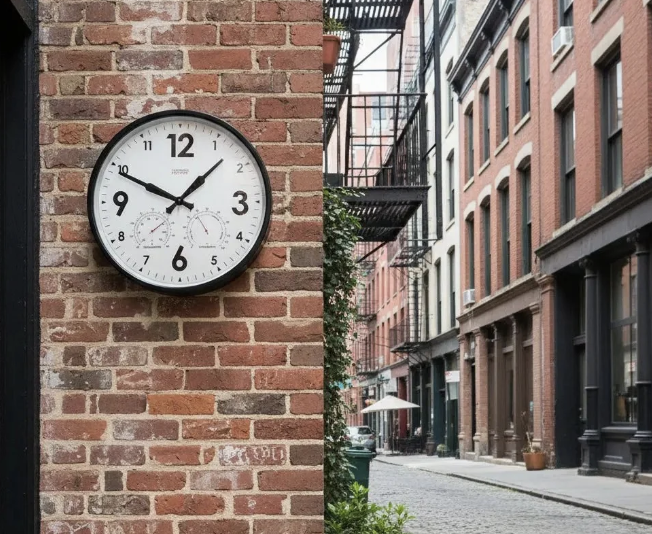
An outdoor clock can make a garden, patio, or pool area more practical and decorative. But outdoors, the clock must handle more than just telling time.
A weatherproof outdoor clock should resist rain, humidity, sunlight, temperature changes, and poolside moisture while remaining easy to read and suitable for the style of the outdoor space.
Choosing the right design, material, size, and installation position can greatly extend its lifespan.
What Makes an Outdoor Clock Truly Weather-Resistant?
A truly weather-resistant outdoor clock is designed to protect its movement, dial, casing, and surface finish from common outdoor conditions.
An outdoor clock is truly weather-resistant when it has a sealed or protected movement, durable casing, UV-resistant dial, rust-resistant parts, and materials that can handle rain, humidity, sunlight, and temperature changes.
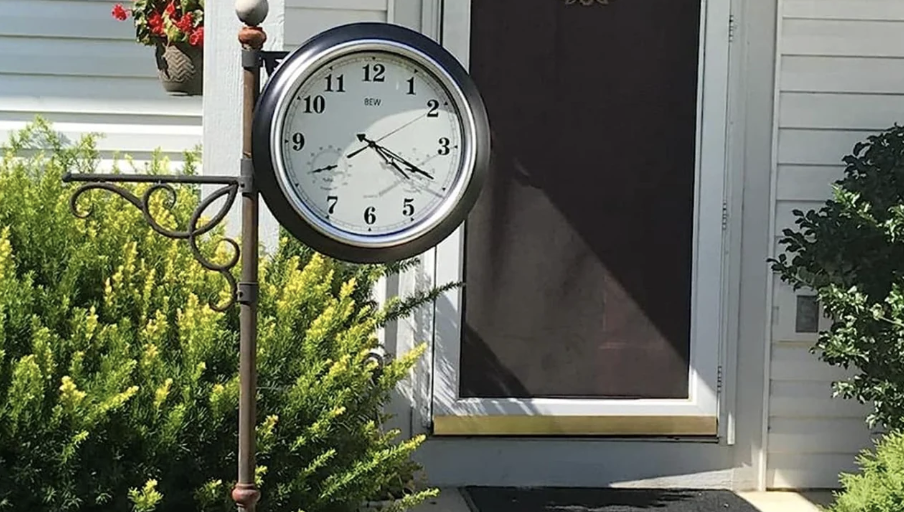
Many clocks are described as “outdoor clocks”, but not all of them are suitable for long-term outdoor use.
Some clocks look beautiful in product photos, but after a few months outside, they may suffer from:
- faded numbers;
- water entering the dial;
- rusty metal parts;
- cracked plastic;
- fogged cover;
- weak movement performance.
This is why buyers should look beyond appearance.
Water resistance is the first requirement
Outdoor clocks do not usually need to be fully waterproof like diving equipment, but they should resist rain and splashing.
This is especially important for:
- garden walls;
- pool areas;
- patios;
- balconies;
- outdoor kitchens.
A good outdoor clock should have a protected back case and a design that reduces water entry.
For pool areas, splash resistance is especially important because the clock may be exposed to both water and chemical moisture.
UV resistance protects appearance
Strong sunlight can damage the clock surface over time.1
UV exposure may cause:
- colour fading;
- yellowing;
- brittle plastic;
- cracked dial surfaces;
- unreadable numbers.
For sunny gardens, UV-resistant printing and coatings are very important.2
Rust resistance matters for metal parts
Outdoor humidity can cause rust on:
- frames;
- hooks;
- screws;
- decorative metal details;
- hanging brackets.
A weather-resistant clock should use suitable materials and finishes, such as powder coating, stainless steel parts, aluminium, or protected iron.
The movement must be protected
The clock movement is the heart of the product.
If moisture enters the movement, the clock may stop or become inaccurate.
Look for:
- covered battery compartments;
- protected movement housing;
- secure back cover;
- good fitting between frame and dial.
| Weather-resistant feature | Why it matters |
|---|---|
| Sealed movement | Protects time accuracy |
| UV-resistant dial | Prevents fading |
| Rust-resistant frame | Extends lifespan |
| Protected battery area | Reduces moisture damage |
| Durable surface coating | Keeps the clock attractive |
A good outdoor clock should be built for real garden conditions, not only indoor decoration.
Which Materials Are Best for Garden and Poolside Clocks?
Material choice affects the clock’s durability, appearance, weight, and price level.
The best materials for garden and poolside clocks include resin, powder-coated metal, aluminium, stainless steel, glass-covered dials, and high-quality outdoor plastics designed to resist moisture, UV exposure, and corrosion.
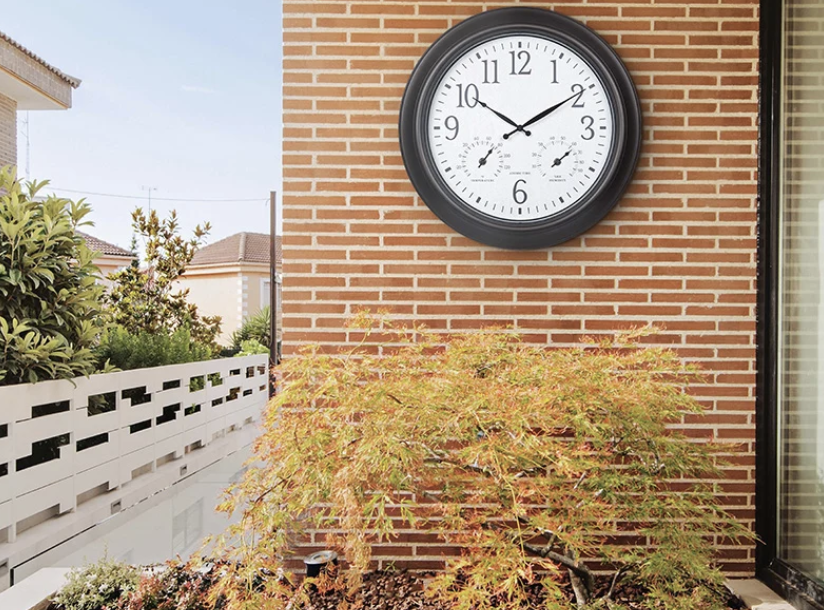
Different outdoor areas need different material choices.
A clock used under a covered patio does not face the same pressure as a clock beside a pool or on an exposed garden wall.
Resin outdoor clocks
Resin is popular for decorative garden clocks.
It can be moulded into many styles, such as:
- stone-effect clocks;
- vintage wall clocks;
- animal-themed designs;
- rustic garden décor;
- classic European styles.
Advantages:
- good decorative flexibility;
- lighter than stone or metal;
- suitable for many shapes;
- resistant to moisture when properly finished.
However, low-quality resin may fade or crack under strong sunlight, so UV protection is important.
Metal outdoor clocks
Metal clocks often look more premium and durable.
Common materials include:
- iron;
- aluminium;
- stainless steel.
Metal clocks are suitable for:
- modern gardens;
- patios;
- poolside walls;
- outdoor dining areas.
The key point is surface treatment.
Untreated metal may rust quickly, especially in wet or coastal areas.
Powder-coated metal, aluminium, and stainless steel perform better outdoors.
Plastic outdoor clocks
Plastic clocks are lightweight and cost-effective.
They are useful for:
- budget retail ranges;
- pool areas;
- casual garden spaces;
- family outdoor areas.
Good outdoor plastic should be UV-stabilised3 and thick enough to resist cracking.
Very cheap plastic can become brittle after long sunlight exposure.4
Glass and acrylic covers
Some outdoor clocks have clear front covers.
These help protect the dial from:
- dust;
- splashes;
- insects;
- moisture.
Glass usually feels more premium, while acrylic is lighter and less likely to break.
For poolside clocks, impact resistance may be important.
Material comparison
| Material | Best use | Main advantage | Main risk |
|---|---|---|---|
| Resin | Decorative gardens | Rich designs | UV fading if low quality |
| Powder-coated metal | Patios and walls | Strong appearance | Rust if coating is damaged |
| Aluminium | Poolside and coastal areas | Corrosion resistance | Higher cost |
| Stainless steel | Premium outdoor use | Long lifespan | More expensive |
| Outdoor plastic | Budget and pool areas | Lightweight | Can become brittle |
| Glass cover | Premium dial protection | Clear visibility | Breakage risk |
The best material depends on where the clock will be used and how much weather exposure it will face.
What Size, Dial Design, and Features Should You Choose?
An outdoor clock must be easy to read from a distance while matching the garden or poolside style.
The best outdoor clock size and dial design depend on viewing distance, installation area, background colour, lighting conditions, and whether extra features such as thermometer or hygrometer functions are needed.
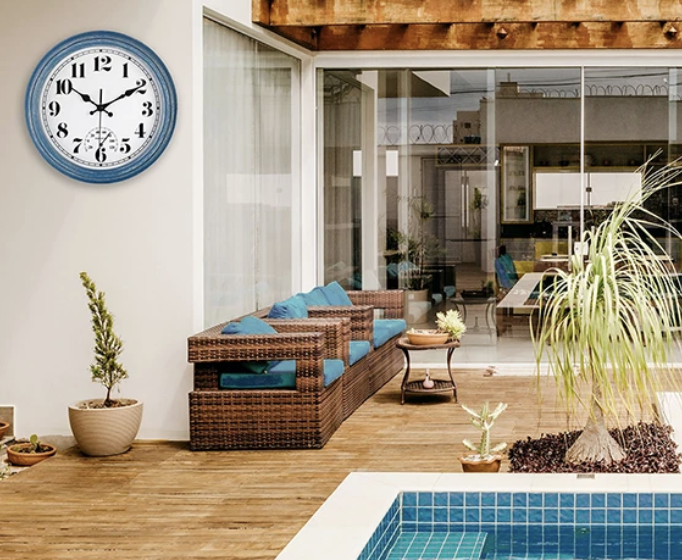
Outdoor clocks are often viewed from farther away than indoor clocks.
A small clock may look attractive on a product page but become difficult to read in a real garden.
Choose the right clock size
For outdoor use, larger sizes are usually more practical.
General guidance:
| Clock size | Best use |
|---|---|
| 20–25 cm | Small balcony or close viewing |
| 30–40 cm | Patio, garden wall, pool area |
| 45–60 cm | Large garden, terrace, outdoor dining space |
| 60 cm+ | Commercial garden, hotel, resort, large pool area |
A clock should be large enough to read comfortably without feeling oversized for the wall.
Dial readability is very important
A good outdoor dial should have:
- large numbers;
- strong contrast;
- clear hands;
- simple markings;
- no overly busy background.
For example, black numbers on a light dial or white numbers on a dark dial are easier to read.
Decorative clocks are attractive, but if the dial is too complex, the product may lose practical value.
Choose the right style
Outdoor clocks are both functional and decorative.
Popular styles include:
- vintage garden clocks;
- rustic farmhouse clocks;
- modern minimalist clocks;
- poolside nautical clocks;
- stone-effect resin clocks;
- metal Roman numeral clocks.
Retailers should match clock styles with customer spaces.
For example:
Garden centre customers may prefer rustic, floral, resin, or traditional designs.
Pool area customers may prefer clean, waterproof, blue, white, or nautical designs.
Modern patio customers may prefer simple metal or minimalist dials.
Thermometer and hygrometer features
Many outdoor clocks include extra features such as:
- thermometer;
- hygrometer;
- combined weather dial;
- dual-sided display.
These features add value, especially for garden and pool areas.
However, accuracy and readability should be checked.
If the extra dials are too small, customers may not use them.
Battery and movement quality
The clock should have:
- stable quartz movement;
- easy battery replacement;
- protected battery cover;
- reliable hands;
- low maintenance design.
A beautiful clock with weak movement will not satisfy customers.
| Feature | Why it matters |
|---|---|
| Large dial | Easier outdoor reading |
| Clear numbers | Better visibility |
| Strong contrast | Useful in bright sunlight |
| Thermometer | Adds garden value |
| Hygrometer | Useful in humid areas |
| Protected battery case | Longer lifespan |
A successful outdoor clock should be easy to read, attractive, and practical for daily outdoor use.
Where Should You Install an Outdoor Clock for the Longest Lifespan?
Even a good weatherproof clock will last longer when installed in the right location.
Install an outdoor clock in a sheltered, visible, and stable position away from constant direct rain, extreme sun exposure, sprinkler spray, pool chemicals, and strong wind whenever possible.
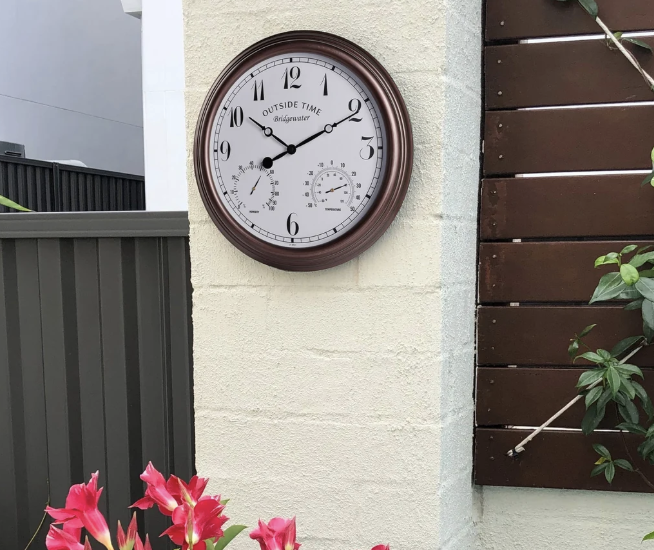
Placement affects lifespan more than many buyers realise.
A clock installed under a covered patio may last much longer than the same clock installed on a fully exposed wall.
Choose a semi-sheltered position
The best installation spots include:
- covered patios;
- garden walls under eaves;
- pergola areas;
- pool houses;
- outdoor kitchens;
- shaded seating areas.
These locations reduce direct exposure while keeping the clock useful.
Avoid constant water exposure
Even weather-resistant clocks should not be placed where water hits them constantly5.
Avoid:
- direct sprinkler spray;
- heavy rain runoff;
- pool splash zones;
- roof drip lines;
- low walls where water collects.
Poolside clocks should be placed far enough from splashing water and chemical mist6.
Avoid extreme direct sunlight
Strong sun can fade dials and damage materials.
If possible, avoid walls that receive intense afternoon sun all summer.
Better positions include:
- morning-sun walls;
- shaded fences;
- covered outdoor areas;
- north-facing or east-facing walls in hot climates.
Mount securely
Outdoor clocks must be fixed safely.
Check:
- wall strength;
- hanging hook quality;
- screw or bracket stability;
- wind exposure;
- clock weight.
Large clocks need stronger mounting than small clocks.
For pool areas, secure mounting is important because children, wind, or accidental contact may create safety risks.
Maintain the clock regularly
Simple maintenance helps extend lifespan.
Useful habits include:
- wipe dust and moisture;
- check battery cover;
- inspect hooks or brackets;
- remove insects or debris;
- replace batteries before leakage;
- check for rust or cracks.
Installation checklist
| Installation point | Recommendation |
|---|---|
| Rain exposure | Choose a sheltered area |
| Sun exposure | Avoid extreme afternoon sun |
| Pool splash | Keep away from direct spray |
| Mounting | Use strong fixings |
| Visibility | Place at comfortable eye level |
| Maintenance | Check regularly |
The right installation position helps turn an outdoor clock into a long-lasting garden feature instead of a short-term decoration.
Conclusion
A good weatherproof outdoor clock should combine durable materials, clear readability, protected movement, and smart installation. Choose based on real outdoor conditions, not appearance alone.
-
"Photodegradation and photostabilization of polymers … – PMC", https://pmc.ncbi.nlm.nih.gov/articles/PMC4320144/. Research on polymer photodegradation shows that ultraviolet radiation in sunlight can alter exposed plastic surfaces, contributing to discoloration, embrittlement, and surface cracking over time. Evidence role: mechanism; source type: paper. Supports: Strong sunlight can damage the clock surface over time.. Scope note: The evidence would support the general material-degradation mechanism rather than testing this specific clock product or garden-clock application. ↩
-
"Photodegradation and photooxidation of thermoset and UV …", https://www.academia.edu/4891087/Photodegradation_and_photooxidation_of_thermoset_and_UV_cured_acrylate_polymers. Studies and technical reviews of UV-stabilized coatings indicate that ultraviolet absorbers and protective coating systems can slow photodegradation and color change in outdoor-exposed materials. Evidence role: general_support; source type: paper. Supports: For sunny gardens, UV-resistant printing and coatings are very important.. Scope note: This supports the rationale for UV-resistant finishes in outdoor use, but it does not quantify how much protection is achieved for every printing method or coating formulation. ↩
-
"Modifications of Polymers through the Addition of Ultraviolet Absorbers to …", https://pmc.ncbi.nlm.nih.gov/articles/PMC8747282/. Materials science sources describe UV stabilizers as additives used to reduce polymer degradation caused by ultraviolet exposure, supporting the relevance of UV stabilization for plastics used outdoors. Evidence role: mechanism; source type: paper. Supports: Good outdoor plastic should be UV-stabilised to better withstand outdoor sunlight exposure.. Scope note: This supports the material mechanism generally, not the durability of any specific clock product. ↩
-
"Photodegradation and photostabilization of polymers …", https://pmc.ncbi.nlm.nih.gov/articles/PMC4320144/. Research on polymer photodegradation shows that prolonged ultraviolet exposure can break down polymer structures and change mechanical properties, including increased brittleness in susceptible plastics. Evidence role: mechanism; source type: paper. Supports: Very cheap plastic can become brittle after long sunlight exposure.. Scope note: The evidence is likely to apply by plastic type and additive package; “very cheap plastic” is a broad commercial category rather than a precise material classification. ↩
-
"Ingress Protection (IP) ratings – IEC", https://iec.ch/ip-ratings. Ingress-protection standards distinguish between limited water exposure, such as splashing or jets, and more demanding conditions such as continuous immersion, supporting the distinction between weather resistance and suitability for constant water contact. Evidence role: definition; source type: institution. Supports: Even weather-resistant clocks should not be placed where water hits them constantly.. Scope note: This supports the general meaning of water-resistance ratings rather than testing any specific clock model. ↩
-
"Study of the Chlorine Influence on the Corrosion of Three …", https://pmc.ncbi.nlm.nih.gov/articles/PMC10058086/. Research on swimming-pool environments documents that chlorinated water and airborne chloramine or chloride-containing aerosols can contribute to material corrosion and degradation, providing contextual support for keeping outdoor devices away from splash and chemical mist. Evidence role: mechanism; source type: paper. Supports: Poolside clocks should be placed far enough from splashing water and chemical mist.. Scope note: The evidence is about pool-environment corrosion generally and may not address outdoor clocks specifically. ↩