
Packaging is not only about protecting products during transportation. For international shipments, packaging information also plays an important role in customs clearance.
Incorrect labels, missing carton markings, inconsistent packaging information, and unclear product identification can create customs delays, additional inspections, extra costs, and unnecessary shipment problems.
For overseas buyers, proper packaging preparation before shipment can help goods move through customs more smoothly.
Why Packaging Information Matters During Customs Clearance
Customs authorities use packaging information to identify, verify, and process imported goods.
Packaging information matters during customs clearance because carton labels, product descriptions, quantities, and shipping marks help customs officers confirm the shipment details and compare them with import documents.

Many importers focus mainly on invoices and customs declarations but overlook packaging details.
However, the information printed on cartons often becomes an important reference during inspection.
Packaging connects physical goods with documents
During customs clearance, authorities may compare:
- commercial invoice;
- packing list;
- carton labels;
- product descriptions;
- declared quantities;
- shipment markings.
If these details do not match, customs may request additional clarification.
For example:
Invoice:
Garden Decoration Set
Carton marking:
Plastic Outdoor Ornament
Customs may question whether both descriptions refer to the same product.
Clear packaging improves inspection efficiency
When cartons are clearly marked, customs officers can identify:
- what the product is;
- how many units are inside;
- which cartons belong to each SKU;
- where the goods come from.
This helps reduce unnecessary delays.1
Clear packaging information is especially important2 for shipments containing:
- multiple products;
- different models;
- mixed colours;
- retail packaging;
- private label products.
Packaging information supports accurate customs declarations
Importers need accurate information for:
- HS code classification;
- duty calculation;
- import records;
- compliance checks.
Packaging mistakes can create uncertainty about:
- product category;
- material;
- quantity;
- intended use.
This may lead to additional questions from customs.
Poor packaging information creates hidden costs
When customs cannot verify shipment details quickly, importers may face:
- warehouse storage fees;
- inspection charges;
- broker service fees;
- delayed delivery;
- additional documentation work.
A small packaging mistake can create a large logistics problem.
| Packaging information | Customs purpose |
|---|---|
| Product name | Identify goods |
| Carton quantity | Verify shipment amount |
| Model number | Match documents |
| Country of origin | Trade verification |
| Shipping marks | Cargo identification |
Proper packaging information helps create a smoother connection between factory shipment and customs clearance.
Common Labeling and Carton Marking Mistakes Importers Should Avoid
Carton labels and shipping marks may seem simple, but small errors can create clearance problems.
Common packaging mistakes include missing product information, incorrect carton quantities, inconsistent descriptions, unclear shipping marks, and labels that do not match import documents.

A professional packaging system should allow anyone handling the shipment to understand the contents quickly.
Missing carton information
One common mistake is shipping cartons with limited information.
Missing details may include:
- product name;
- model number;
- quantity;
- carton number;
- country of origin;
- customer reference.
Without clear identification, customs and warehouse teams may need extra verification.
Incorrect product descriptions
Product descriptions should be:
- accurate;
- consistent;
- easy to understand.
Avoid descriptions that are:
- too general;
- misleading;
- different from the invoice.
Examples of weak descriptions:
❌ Decoration
❌ Parts
❌ Plastic item
Better descriptions:
✅ Outdoor resin garden decoration
✅ Metal garden fence panel
✅ Battery-operated LED Christmas ornament
Inconsistent quantity information
Quantity mistakes are another common issue.
Examples:
Packing list:
20 pcs/carton
Carton label:
24 pcs/carton
This creates uncertainty during inspection.
Missing shipping marks
Shipping marks help identify cargo.3
They may include:
- buyer name;
- order number;
- carton number;
- destination;
- handling instructions.
For large shipments, missing marks make warehouse management more difficult4.
Incorrect warning labels or handling marks
Some products require special marks.
Examples:
- fragile products;
- moisture-sensitive products;
- electrical products;
- products with batteries.
Missing required markings may cause additional questions.
Wrong barcode or retail labels
For retail products, incorrect labels can create problems after customs clearance.
Common issues:
- wrong barcode;
- missing SKU;
- incorrect country information;
- mismatched retail packaging.
| Label mistake | Possible result |
|---|---|
| Missing product name | Customs clarification |
| Wrong quantity | Inspection request |
| Incorrect description | Classification review |
| Missing shipping mark | Cargo identification problems |
| Wrong barcode | Retail problems |
Accurate labels help importers avoid unnecessary questions during customs processing.
How Incorrect Packaging Can Trigger Inspections and Additional Costs
Packaging problems do not always stop a shipment immediately, but they can increase the chance of customs inspection.
Incorrect packaging can trigger inspections when authorities cannot confirm product identity, quantity, material information, declared value, or compliance requirements from the shipment details.
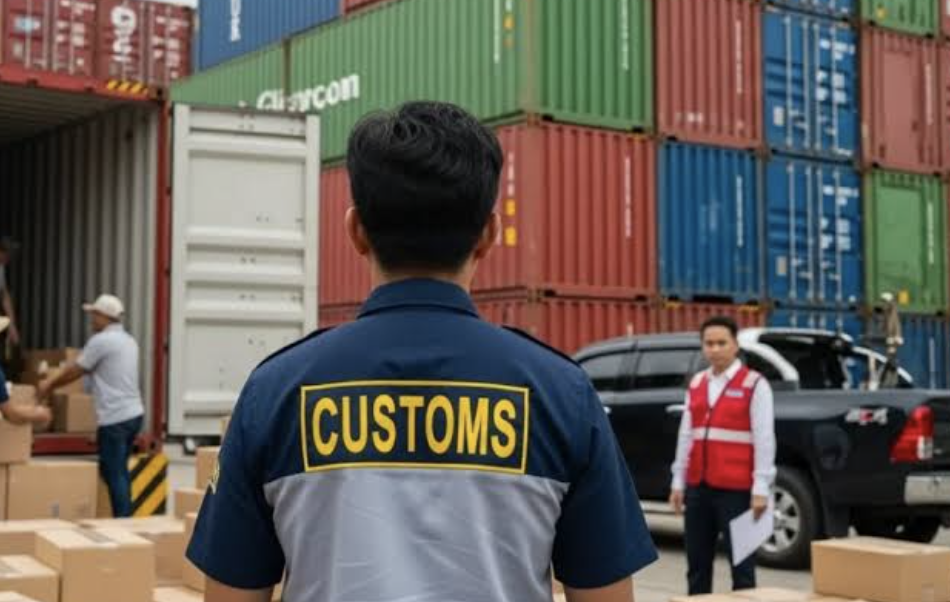
Customs inspections are designed to verify that imported goods match the declaration.
Packaging problems can make this verification more difficult.
Mismatch between cartons and documents
One of the most common triggers is inconsistency.
Examples:
- carton labels show different product names;
- quantities do not match;
- packaging shows another brand;
- product photos differ from descriptions.
Customs may request further information.
Unclear product categories
Some products can fall into different customs categories depending on:
- material;
- function;
- intended use.
Poor packaging descriptions can create classification uncertainty.
Examples:
A product described only as:
Garden item
does not provide enough information.
A better description explains:
- material;
- function;
- application.
Missing compliance information
Certain products require additional checks.
Packaging may need to include information such as:
- manufacturer details;
- importer details;
- warnings;
- product identification.
Missing information may result in additional review.
Additional inspection costs
When shipments are delayed, importers may pay:
- terminal storage fees;
- inspection fees;
- customs broker charges;
- warehouse handling fees.
These costs are often much higher than improving packaging before shipment.
Delays affect the entire supply chain
- warehouse planning;
- customer delivery dates;
- promotional schedules;
- inventory availability.
For seasonal goods, timing is especially important.6
Examples:
- Christmas decorations;
- gardening products;
- promotional items.
How to reduce inspection risks
Importers should:
- confirm packaging requirements early;
- review carton markings before shipment;
- compare packaging with documents;
- request pre-shipment photos;
- conduct final checks.
| Packaging problem | Possible customs impact |
|---|---|
| Wrong description | Product review |
| Missing labels | Additional verification |
| Quantity mismatch | Physical inspection |
| Unclear materials | Classification delay |
| Missing importer information | Compliance questions |
Good packaging preparation helps reduce customs risks before goods leave the factory.
A Pre-Shipment Packaging Checklist for Overseas Buyers
Before shipment, overseas buyers should complete a final packaging review to prevent avoidable customs and logistics problems.
A pre-shipment packaging checklist should verify carton labels, product information, quantities, shipping marks, documents, packaging condition, and compliance-related requirements before the container leaves China.

The final packaging check is the last opportunity to correct mistakes before international transportation begins.
Check carton labels
Confirm that every carton includes the correct information.
Check:
- product name;
- model number;
- quantity;
- carton number;
- customer information;
- country of origin.
Match packaging with documents
Compare:
| Item | Check |
|---|---|
| Invoice | Product description |
| Packing list | Carton quantity |
| Carton label | SKU information |
| Purchase order | Product details |
All information should be consistent.
Verify shipping marks
Confirm:
- buyer mark;
- destination;
- order number;
- carton sequence;
- special instructions.
This helps customs and warehouses identify cargo.
Check packaging quality
Packaging itself should also be inspected.
Review:
- carton strength7;
- sealing quality;
- moisture protection;
- product protection;
- pallet condition if used.
Damaged packaging may create concerns during inspection.8
Confirm special requirements
Depending on product type and destination, check:
- warning labels;
- compliance marks;
- importer information;
- language requirements;
- recycling symbols.
Take final packaging photos
Before loading, buyers should request:
- carton photos;
- labels;
- finished products;
- container loading photos.
These records help solve future questions.
Final packaging checklist
| Check item | Completed |
|---|---|
| Carton labels correct | ✓ |
| Quantity matches documents | ✓ |
| Product description accurate | ✓ |
| Shipping marks applied | ✓ |
| Packaging condition approved | ✓ |
| Required labels included | ✓ |
| Photos collected | ✓ |
A complete packaging review helps buyers prevent customs problems before shipment departure.
Conclusion
Packaging mistakes can create unnecessary customs delays and extra costs. By preparing accurate labels, consistent documents, and proper carton markings, importers can achieve smoother international shipments.
-
"560776 – CROSS Ruling – U.S. Customs and Border Protection", https://rulings.cbp.gov/ruling/560776. Customs guidance indicates that accurate shipment descriptions, quantities, package markings, and country-of-origin information help officers verify goods and process entries; this supports the claim that clear carton information can reduce avoidable customs delays, although it does not quantify the delay reduction attributable to carton markings alone. Evidence role: mechanism; source type: government. Supports: Clear carton markings help customs officers identify shipment contents and origin, which can reduce unnecessary delays.. Scope note: Contextual support; the source may discuss customs documentation and marking requirements generally rather than measuring delay outcomes from carton labels specifically. ↩
-
"19 CFR Part 141 Subpart F — Invoices – eCFR", https://www.ecfr.gov/current/title-19/chapter-I/part-141/subpart-F. International trade documentation guidance describes packing lists and package marks as tools for identifying the contents, quantities, and package-level details of a shipment; this supports the need for clear packaging information in mixed or varied consignments, but it does not specifically evaluate retail packaging, colour variants, or private-label goods as separate risk categories. Evidence role: general_support; source type: institution. Supports: Clear packaging information is particularly important when shipments include multiple products, models, colours, retail packaging, or private-label products.. Scope note: Contextual support; the evidence is likely to address mixed shipments and package identification broadly, not every listed shipment type individually. ↩
-
"Marking & Labeling Your Shipment | Federal Aviation Administration", https://www.faa.gov/hazmat/safecargo/how_to_ship/mailing_labeling. Standard shipping documentation guidance describes shipping marks as identifiers placed on packages to distinguish and trace cargo during transport and handling. Evidence role: definition; source type: institution. Supports: Shipping marks help identify cargo.. Scope note: This supports the general function of shipping marks rather than any specific carrier or shipment scenario. ↩
-
"[PDF] Improved Warehouse for SMT Material Management Using Modern …", https://cornerstone.lib.mnsu.edu/cgi/viewcontent.cgi?article=2230&context=etds. Logistics and warehouse management literature notes that clear item and package identification supports receiving, sorting, storage, and inventory control, so absent or incomplete markings can create handling and tracking inefficiencies. Evidence role: mechanism; source type: paper. Supports: For large shipments, missing marks make warehouse management more difficult.. Scope note: The source may discuss labeling or identification systems broadly rather than shipping marks specifically. ↩
-
"[PDF] PREDICTING LATE DELIVERIES IN INTERNATIONAL …", https://scholarworks.lib.csusb.edu/cgi/viewcontent.cgi?article=3437&context=etd. Research on supply-chain disruption and port/customs clearance delays documents that border-related delays can affect inventory levels, delivery reliability, and downstream logistics planning. Evidence role: general_support; source type: paper. Supports: A customs delay can affect warehouse planning, customer delivery dates, promotional schedules, and inventory availability.. Scope note: The source may discuss customs or border delays as one category of supply-chain disruption rather than proving each listed operational impact separately. ↩
-
"Inventory Management – Business Operations Analytics", https://pressbooks.usnh.edu/businessopsanalytics/chapter/inventory-management/. Operations and inventory-management literature on seasonal demand shows that products with concentrated selling periods require timely availability because missed selling windows can lead to lost sales or excess inventory after the season. Evidence role: expert_consensus; source type: paper. Supports: Timing is especially important for seasonal goods.. Scope note: This supports the general importance of timing for seasonal goods, not the specific examples listed in the article. ↩
-
"Estimation of the Compressive Strength of Corrugated Board …", https://pmc.ncbi.nlm.nih.gov/articles/PMC8467740/. Transport-packaging standards and guidance discuss corrugated carton compression and stacking strength as factors in protecting goods during distribution and handling. Evidence role: mechanism; source type: institution. Supports: Carton strength should be reviewed when inspecting packaging.. Scope note: This supports the relevance of checking carton strength generally, but the required strength depends on product weight, transport mode, and storage conditions. ↩
-
"Businessperson’s Guide to Federal Warranty Law", https://www.ftc.gov/business-guidance/resources/businesspersons-guide-federal-warranty-law. Import and product-inspection guidance commonly treats damaged or compromised packaging as a possible indicator of mishandling, contamination risk, or inadequate product protection during storage and transport. Evidence role: general_support; source type: government. Supports: Damaged packaging may raise concerns during inspection.. Scope note: The source would support packaging damage as a risk indicator, not prove that every instance of damaged packaging reflects product damage or nonconformity. ↩