Every Christmas season, I see one thing clearly: customers may buy fewer decorations, but they want each piece to look more special.
The biggest Christmas wreath trends for 2026 are sustainable materials, oversized statement designs, minimalist styling, and pre-lit LED wreaths that create instant holiday atmosphere.
For retailers, the best opportunity is to offer wreaths that feel reusable, premium, easy to display, and suitable for modern homes.
Why Sustainable Christmas Wreaths Are Gaining Popularity
Customers are becoming more careful about waste, storage, and how long seasonal decorations can be used.
Sustainable Christmas wreaths are gaining popularity because shoppers want reusable designs, recyclable packaging, durable artificial foliage, natural materials, and products that still look good after several holiday seasons.

Christmas decorations are emotional purchases. People want their homes to feel warm and festive.
But they do not want to throw away damaged decorations after one season.
That is why sustainability is becoming more practical, not just fashionable.
Reusable wreaths offer better long-term value
A wreath that can be used for three, four, or five Christmas seasons feels like a better purchase.
- strong wreath frames;
- dense foliage that does not shed;
- colours that do not fade quickly;
- ornaments that stay attached;
- ribbons that can keep their shape;
- packaging that supports easy storage.
The message is simple: buy once, enjoy for years.
For retailers, this supports a stronger “quality value” story[^2] than selling very cheap disposable decorations.
Natural materials are still attractive
Natural wreath styles continue to appeal to customers who prefer warm, rustic, handmade décor.
Popular materials include:
- willow;
- rattan;
- grapevine;
- pinecones;
- dried branches;
- dried flowers;
- jute ribbon;
- natural berries;
- moss;
- wooden decorations.
These materials work well for farmhouse, cottage, Scandinavian, and natural home styles.
However, natural products need careful storage and packaging. Moisture, breakage, mould, and insects can create quality problems if they are not controlled properly.
Artificial wreaths can also support sustainability
Artificial wreaths are not automatically unsustainable.
A well-made artificial wreath can be reused for many years. In fact, a durable PE/PVC wreath with replaceable decorations may create less seasonal waste than a low-quality product that is discarded after one winter.
Retailers can improve the sustainability message by offering:
- reusable wreath bases;
- removable ornaments;
- detachable ribbons;
- replaceable LED light strings;
- recyclable carton packaging;
- reduced plastic inner packing.
Sustainable packaging matters too
Customers increasingly notice overpacking.
Large plastic bags, excessive foam, and bulky retail packaging can weaken an eco-friendly product message.
Better options include:
- recyclable cartons;
- paper wraps;
- minimal plastic bags;
- compact storage boxes;
- clear storage instructions;
- nesting or flat-pack structures where possible.
| Sustainable feature | Why customers like it | Retail benefit |
|---|---|---|
| Reusable wreath base | Can be styled every year | Repeat accessory sales |
| Durable foliage | Better long-term value | Fewer returns |
| Natural materials | Warm handmade look | Strong storytelling |
| Recyclable packaging | Less visible waste | Better brand image |
| Replaceable decoration parts | Easier repair and refresh | Longer product life |
For premium retail ranges, I like the idea of a wreath customers can refresh every year instead of replacing completely.
Large Decorative Wreaths: The New Holiday Statement Piece
Large wreaths are becoming more popular because customers want one strong focal point instead of many small decorations.
Large decorative wreaths are trending in 2026 because they create an instant statement on doors, walls, fireplaces, shop windows, hotel entrances, and outdoor spaces. Oversized designs make homes feel festive with less clutter.

A large wreath has visual power.
It can make a plain door feel expensive. It can turn a fireplace wall into a holiday centrepiece. It can also make a retail window look finished without adding dozens of separate products.
Bigger wreaths create stronger visual impact
Popular sizes for statement wreaths may include:
- 60 cm;
- 75 cm;
- 90 cm;
- 100 cm;
- 120 cm and above for commercial displays.
For many customers, a 30 cm or 40 cm wreath can look too small on a large front door.
Oversized wreaths solve this problem.
They work especially well for:
- wide entrance doors;
- double doors;
- tall ceilings;
- large fireplaces;
- outdoor wall displays;
- shopfronts;
- restaurants;
- hotels;
- event venues.
Large wreaths suit premium holiday décor
Large designs naturally feel more luxurious[^3] because they use:
- more foliage;
- deeper layers;
- larger bows;
- bigger ornaments;
- stronger frames;
- better shape control.
The key is not simply making the wreath bigger.
A large wreath must still look balanced.
If the foliage is too thin, it looks empty. If decorations are too heavy, it can sag. If the frame is weak, the wreath may deform during transport.[^4]
Statement wreath styles for 2026
Popular large wreath concepts include:
- full green pine wreaths with warm LEDs;
- champagne and gold luxury wreaths;
- oversized velvet bow wreaths;
- frosted winter greenery;
- natural pinecone and berry wreaths;
- eucalyptus and neutral-tone wreaths;
- modern black, green, and gold designs;
- minimal greenery rings with one focal bow.
Large wreaths are especially useful for retail displays because they help customers imagine how the product will look at home.
Packaging is critical for large wreaths
Oversized wreaths are more difficult to ship.
Retailers and importers should check:
- frame strength;
- carton dimensions;
- shape protection;
- compression resistance;
- ornament protection;
- bow protection;
- hanging hook strength;
- stacking limits.
A large wreath that arrives flattened or bent can quickly become a return problem.
| Large wreath type | Best display location | Main quality focus |
|---|---|---|
| 60–75 cm standard oversized wreath | Front doors and fireplaces | Fullness and shape |
| 90–120 cm statement wreath | Large walls and shop windows | Frame strength |
| Pre-lit large wreath | Evening displays | LED wiring and light spacing |
| Natural oversized wreath | Rustic interiors | Breakage and moisture control |
| Commercial display wreath | Hotels and retail stores | Installation structure |
For retailers, I recommend showing large wreaths as a complete holiday focal point, not just another item on a shelf.
Minimalist Christmas Wreath Styles for Modern Interiors
Modern customers often want Christmas décor that feels calm, stylish, and easy to match with their existing home interiors.
Minimalist Christmas wreaths are popular because they use clean shapes, limited colours, natural textures, and simple details. They suit modern homes where customers want festive warmth without heavy glitter or crowded decoration.
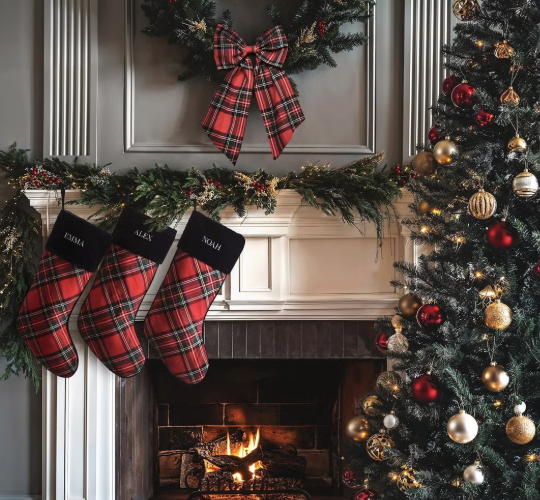
Minimalist does not mean boring.
It means every detail has a purpose.
A minimalist wreath may use only:
- one type of greenery;
- one ribbon;
- one colour accent;
- one small ornament cluster;
- one natural material;
- one warm light feature.
This controlled style often looks more premium than a wreath covered with random decorations.
Greenery-only wreaths remain strong
A simple greenery wreath with no ornaments can feel elegant and modern.
Popular foliage choices include:
- pine;
- eucalyptus;
- cedar;
- olive leaves;
- mixed winter greenery;
- artificial fern;
- frosted branches.
The quality of the greenery matters more when the design is simple.
Customers can easily notice:
- thin foliage;
- visible wire;
- plastic shine;
- weak shaping;
- uneven colour;
- poor branch density.
For minimalist styles, the wreath base itself must look good.
Neutral colours suit modern homes
Minimalist wreaths often use colours such as:[^5]
- deep green;
- warm white;
- beige;
- cream;
- soft grey;
- natural brown;
- muted gold;
- matte black;
- champagne.
These shades work well with modern doors, neutral walls, wood furniture, and black metal details.[^6]
A simple green wreath with a linen ribbon can fit more homes than a heavily decorated bright-red design.
Asymmetrical designs are becoming more common
Instead of decorating the whole wreath evenly, many modern designs place greenery or ornaments on one side only.
This can create a clean, artistic look.
Examples include:
- half-covered eucalyptus wreath;
- one-side frosted pine wreath;
- gold accent cluster on one corner;
- single velvet bow at the bottom;
- open metal ring with partial greenery.
Asymmetrical wreaths often look especially good on interior walls, mirrors, and modern entryways.
Minimalist styles work well for small spaces
Large traditional wreaths can feel heavy in apartments or smaller homes.
A slim wreath, open ring, or simple foliage design gives customers a festive option without making the space feel crowded.
This is useful for:
- apartments;
- small balconies;
- office doors;
- indoor walls;
- compact entryways;
- modern flats.
| Minimalist wreath style | Suitable home style | Main feature |
|---|---|---|
| Greenery-only wreath | Scandinavian and modern homes | Clean natural texture |
| Open metal ring wreath | Industrial and contemporary interiors | Simple structure |
| Eucalyptus wreath | Soft neutral interiors | Light, calm colour |
| Asymmetrical wreath | Trend-led modern spaces | Artistic focal point |
| Single-bow wreath | Minimal luxury décor | Controlled colour accent |
My favourite minimalist rule is one strong texture, one clear colour, one focal detail.
LED and Pre-Lit Wreath Innovations Shaping the 2026 Market
Customers want holiday lighting that looks warm, works easily, and does not create extra setup work.
LED and pre-lit wreath innovations are shaping the 2026 market by combining artificial greenery with warm lighting, timer functions, remote controls, battery boxes, and flexible display options for doors, walls, fireplaces, and commercial spaces.
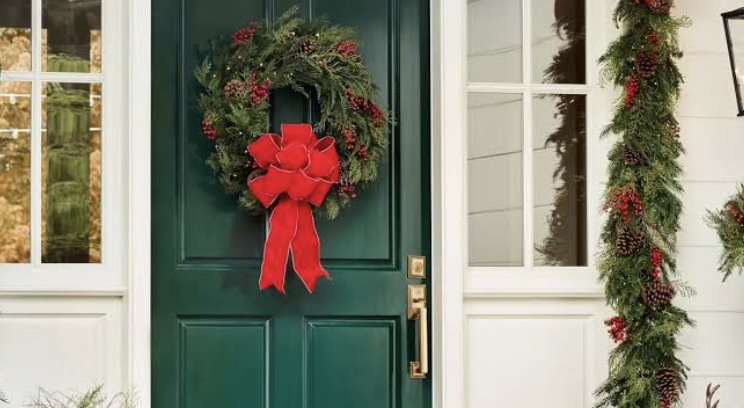
Pre-lit wreaths solve a practical problem.
Customers love the look of lights, but many dislike wrapping loose string lights around a wreath.
A pre-lit product offers instant atmosphere.
Warm white lighting remains the safest choice
Warm white LEDs are still the strongest choice for premium holiday décor.
They create a soft, cosy look that works with:
- green foliage;
- gold ornaments;
- red berries;
- neutral interiors;
- wooden doors;
- modern homes;
- traditional Christmas displays.
Cool white lighting can look clean and icy, but it may feel less warm in a home environment.
For most retailers, warm white is the safer main collection, while cool white can be offered as a smaller alternative range.
Timer functions improve customer experience
A simple timer can make a wreath much more attractive.
For example, customers may want lights to switch on automatically in the evening and turn off later at night.
Useful features include:
- 6-hour timer;
- 8-hour timer;
- memory function;
- on/off button;
- remote control;
- multiple light modes;
- dimming options.
However, more features also mean more quality checks.
A basic, reliable timer may be better than a complicated product with poor instructions.
Battery-powered designs offer flexible placement
Battery-powered pre-lit wreaths can be used where plug sockets are not convenient.
They work well for:
- front doors;
- interior walls;
- staircases;
- fireplaces;
- shop windows;
- outdoor covered areas;
- temporary event décor.
The battery box should be:
- easy to access;
- securely attached;
- weather-protected where needed;
- hidden but not difficult to open;
- strong enough for repeated use.
USB and plug-in wreaths are growing too
Some customers prefer USB-powered or plug-in wreaths for indoor use.
These can reduce battery replacement and provide longer running time[^7].
Retailers should clearly separate:
- indoor-only products;
- outdoor covered-use products;
- weather-resistant products;
- plug-in products;
- battery-powered products.
Clear labelling reduces customer confusion and returns.[^8]
Smart lighting is a niche but growing category
Some premium products may include:
- app control;
- colour-changing LEDs;
- music sync;
- programmable light patterns;
- voice assistant connection.
These features can attract younger or technology-focused customers.
However, smart wreaths should be tested carefully for:
- app stability;
- connection reliability;
- waterproofing;
- battery life;
- instructions;
- compliance requirements;
- after-sales support.
For mainstream retail, simple warm LED lighting with timer control is often the best balance between value and reliability.
| LED feature | Customer benefit | Retailer quality focus |
|---|---|---|
| Warm white LEDs | Cozy premium look | Light colour consistency |
| Battery operation | Flexible placement | Battery box durability |
| Timer function | Convenient daily use | Reliable switching |
| Remote control | Easy access | Signal range |
| USB connection | Reusable indoor power | Cable strength |
| Smart lighting | Customised effects | App and electronics support |
For most buyers, the winning product is a pre-lit wreath that simply works every evening.
Conclusion
Christmas wreath trends for 2026 combine sustainability, oversized drama, minimalist elegance, and warm LED convenience—giving retailers strong options for every home style.
[^1]: "A National Study of Purchasing Factors Across Eighteen Product …", https://www.sciencedirect.com/science/article/pii/S2212827117309514. Consumer research on durable and sustainable consumption finds that product longevity, material quality, and reusability are recurring factors in purchase evaluation, which provides contextual support for linking wreath features such as strong frames, non-shedding foliage, and storage-friendly packaging to buyer expectations. Evidence role: general_support; source type: institution. Supports: Customers increasingly evaluate wreaths by durability-related features such as frame strength, foliage retention, colour stability, attachment quality, ribbon shape retention, and storage packaging.. Scope note: The evidence is likely to describe broader consumer-goods or home-products preferences rather than Christmas wreaths specifically.
[^2]: "Understanding the Influence of Consumers’ Perceived Value … – PMC", https://pmc.ncbi.nlm.nih.gov/articles/PMC8844988/. Research on perceived value and product quality indicates that consumers often associate higher durability and longer useful life with better value, supporting the claim that retailers can frame reusable seasonal decorations around quality-based value rather than only low price. Evidence role: expert_consensus; source type: paper. Supports: Retailers can make a stronger value proposition by emphasizing the quality and multi-season durability of wreaths instead of positioning them as cheap disposable decorations.. Scope note: This support is theoretical and general to consumer behavior; it does not directly prove sales performance for Christmas wreaths.
[^3]: "Effects of Design Aesthetics on the Perceived Value of a Product", https://pmc.ncbi.nlm.nih.gov/articles/PMC8359925/. Research on perceived luxury and product aesthetics indicates that consumers often associate luxury with cues such as superior materials, craftsmanship, visual richness, and aesthetic refinement; this supports the contextual claim that larger, fuller wreath designs can signal luxury through abundance and layered detail. Evidence role: general_support; source type: paper. Supports: Large wreath designs can feel more luxurious because their scale allows more foliage, layering, ornaments, and shape refinement.. Scope note: The evidence would support luxury perception in product/design contexts generally, not prove that wreath size alone causes a luxury perception.
[^4]: "Mechanics of Materials: Beam Deflection – Boston University", https://www.bu.edu/moss/mechanics-of-materials-beam-deflection/. Materials and structural mechanics sources explain that members with lower stiffness undergo greater deflection under applied loads, and transport handling can introduce dynamic loads; this supports the mechanism by which a weak wreath frame may deform in transit. Evidence role: mechanism; source type: education. Supports: A weak frame can deform during transport because insufficient stiffness increases deflection under load and handling stresses.. Scope note: The support is based on general mechanics and transport-load principles rather than a wreath-specific test.
[^5]: "[PDF] Influential Styles From Baroque To Bauhaus Inspira – extnag.tacc …", https://extnag.tacc.utexas.edu/ProductPdf/u10DA9/242104/Influential%20Styles%20From%20Baroque%20To%20Bauhaus%20Inspira.pdf. A scholarly or educational source on minimalist design can substantiate that minimalism is commonly associated with restrained palettes, neutral tones, and limited ornamentation; this supports the colour-list framing as a design convention rather than as a measured trend. Evidence role: general_support; source type: education. Supports: Minimalist wreaths commonly use restrained, neutral, or muted colours such as green, beige, cream, grey, natural brown, muted metallics, black, and champagne.. Scope note: The source may support minimalist colour principles generally, not wreath design specifically.
[^6]: "Color Theory in Interior Design: Crafting the Perfect Palette – RMCAD", https://www.rmcad.edu/blog/color-theory-in-interior-design-crafting-the-perfect-palette/. An interior-design or colour-theory source can support that neutral palettes are widely used for visual compatibility with modern interiors and natural materials; the evidence is contextual because it addresses general design harmony rather than testing wreath-and-door combinations directly. Evidence role: mechanism; source type: education. Supports: Neutral and muted wreath colours coordinate with modern architectural elements, neutral walls, wood furniture, and black metal details.. Scope note: This would support the general design rationale, not prove that every listed shade suits every home exterior or interior.
[^7]: "[PDF] M&V Guidelines: Measurement and Verification for Performance", https://www.energy.gov/sites/default/files/2024-10/mv_guide_5_0.pdf. Technical sources on battery capacity and externally powered electrical devices support the mechanism that USB or mains-powered decorative lighting is not constrained by disposable battery capacity during operation. Evidence role: mechanism; source type: education. Supports: USB-powered or plug-in wreaths can reduce battery replacement and provide longer running time compared with battery-powered versions.. Scope note: This would support the power-source mechanism generally, not prove specific runtime performance for every wreath model.
[^8]: "Consumer confusion about wholegrain content and healthfulness in …", https://pubmed.ncbi.nlm.nih.gov/32773004/. Research on product information quality and consumer decision-making supports the view that clearer product descriptions and labels can reduce misunderstanding and post-purchase dissatisfaction, which are associated with product returns. Evidence role: general_support; source type: paper. Supports: Clear product labelling reduces customer confusion and returns.. Scope note: Evidence may address product information quality and returns broadly rather than wreath-category labelling specifically.